How ChatGPT Chooses Which Brands to Recommend

Andy

Search has worked around a familiar model for over 20 years: businesses publish webpages, search engines crawl and rank them, then visitors decide which result to click. That idea is still important, but it’s simply no longer a reliable way to expect how people behave online.
AI assistants increasingly sit between the question and the decision. People ask for supplier recommendations, product comparisons, buying advice, travel plans, software shortlists and summaries of complex topics. Instead of scanning ten blue links, they may receive a single answer that brings together several sources and suggests a smaller number of options.
The scale of that behaviour change is significant. OpenAI said in early 2026 that ChatGPT had more than 900 million weekly active users. Its 2025 consumer-use research also found that almost half of messages were classified as “asking”: users seeking information, guidance or advice rather than simply requesting a task to be completed. Google, meanwhile, expanded AI Overviews to more than 200 countries and territories and more than 40 languages in 2025. AI-generated responses are becoming part of mainstream search behaviour, not a separate experiment used only by early adopters.
The line of inquiry we’re seeing our clients and other businesses start exploring has moved from “How do we rank for xyz?” to “How do we get more clicks through ChatGPT?”. This is becoming the new vanity metric and holy grail KPI to negotiate.
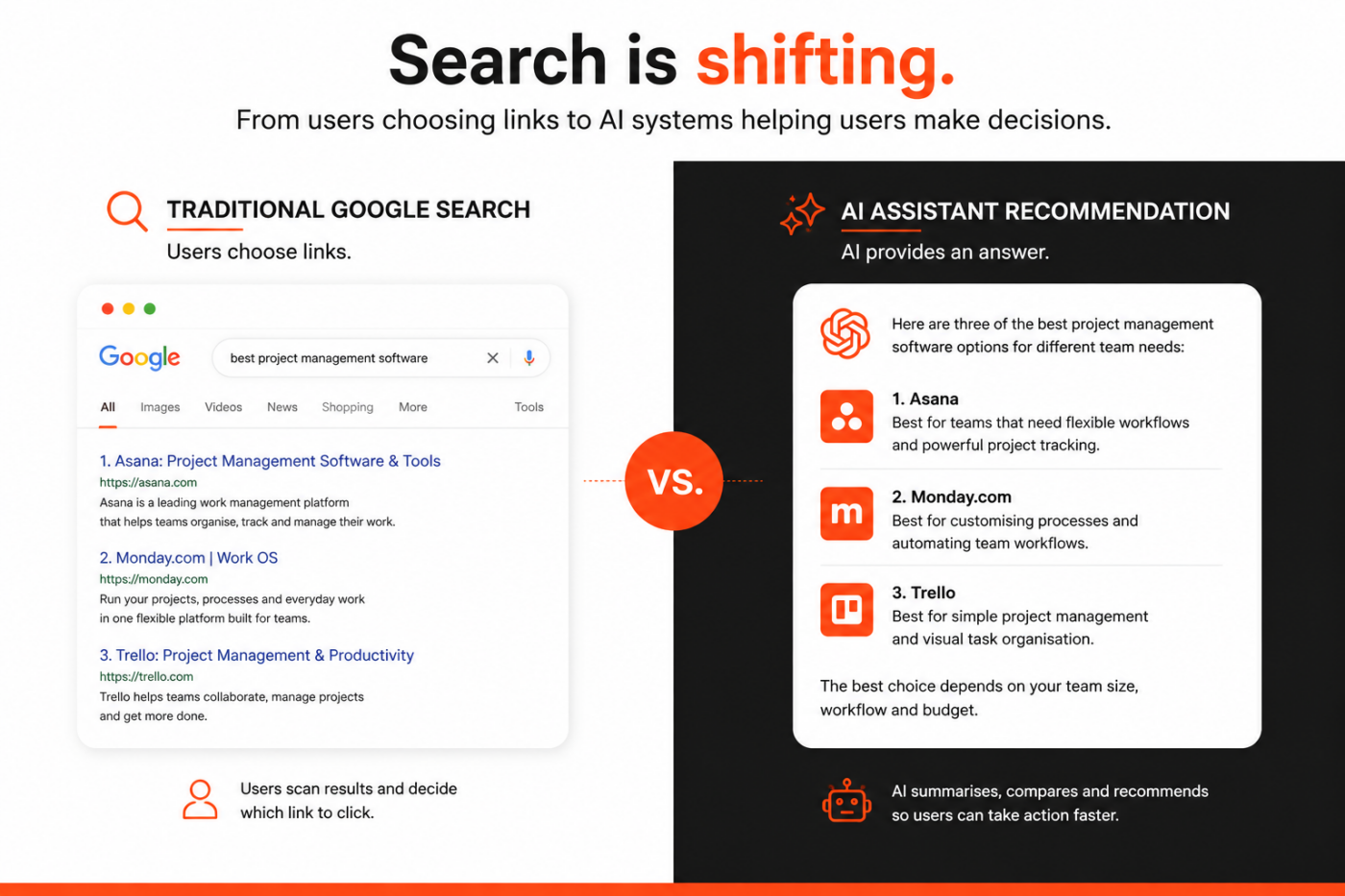
Traditional search engines (Google, Bing, Jeeves) crawl pages, store information in an index and rank URLs against a query. The result is usually a list of pages, shaped by hundreds of signals and the search engine’s quality systems.
A conversational AI system works differently, much more akin to a chatbot. A language model generates an extremely comprehensive answer based on patterns learned during months of continually refined training. Depending on the product, plan, question and available tools, it may also retrieve current information from the web, search connected sources, analyse uploaded material or use specialist data services. The final response can combine information rather than simply ranking one page above another.
This then makes sense when we acknowledge there’s simply no published list of “ChatGPT ranking factors” comparable to a traditional SEO checklist. The precise sources and processes involved can vary. The same prompt may also produce different answers as models, retrieval systems, available data and user context change. Our early micro-study of analytics from both ChatGPT against Gemini will be interesting to look back on in another 6 months time.
That does not mean visibility is random. Recommendation-style answers still need evidence. An AI system is more likely to present a brand confidently when the available information makes the business easy to identify, relevant to the request and supported by credible sources. The work is less about manipulating a single algorithm and more about reducing uncertainty.
No individual signal guarantees a ChatGPT citation. However, the following areas when strategically implemented together can help build the confidence an AI system needs when it is asked to explain, compare or recommend.
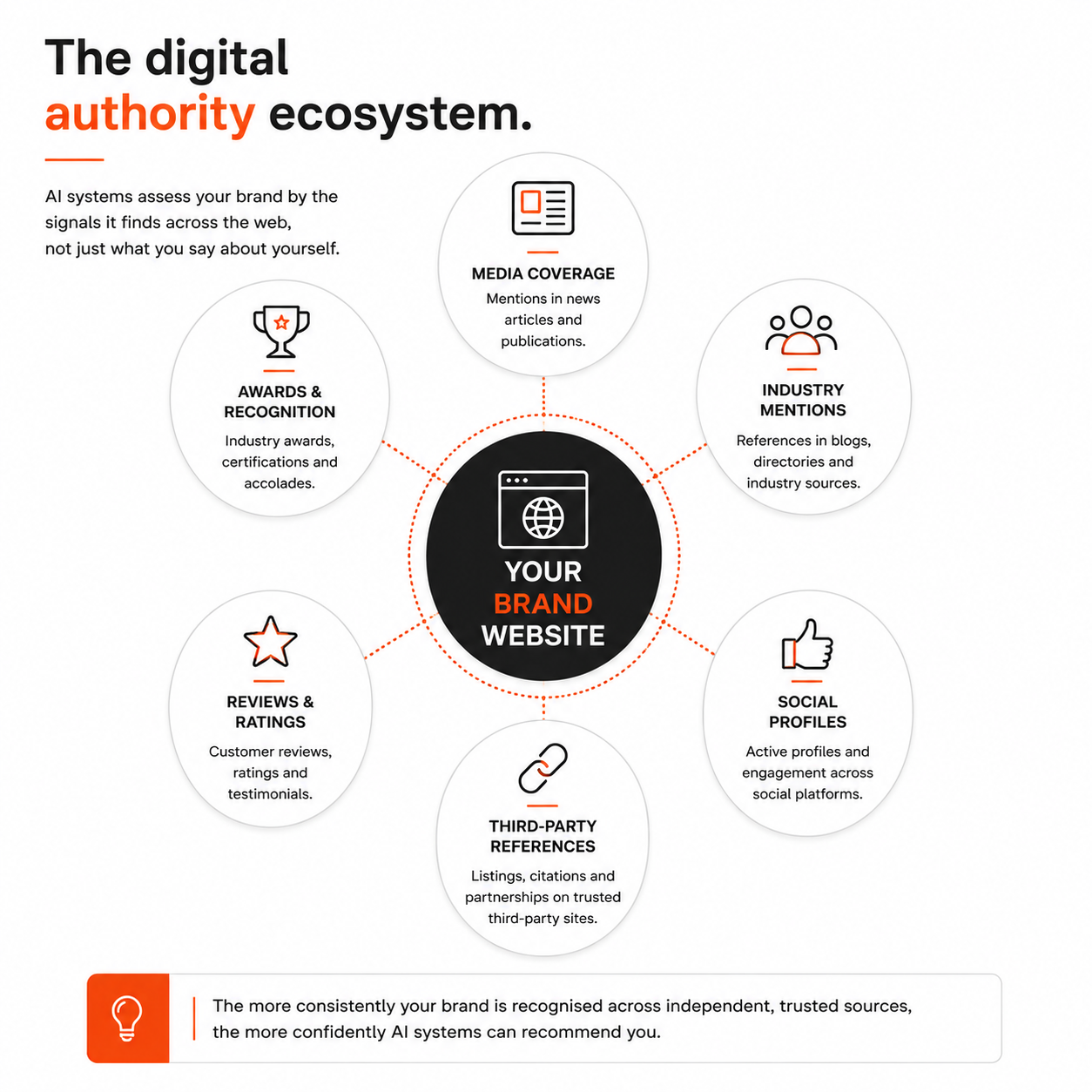
A business that exists only on its own website presents a limited evidence base – it’s like a closed shop window where people need to force themselves inside to see what’s going on. It’s not going to happen. On the other hand, a business referenced by trade publications, professional bodies, respected partners, review platforms, conference organisers and customers has a clearer and more trusted digital footprint.
These third-party references help establish that the brand is real, active and recognised in a particular market. They can also clarify its specialist areas. A manufacturer described consistently as an expert in precision engineering sends a stronger signal than one whose external mentions are sparse or unrelated.
Useful authority signals may include earned media coverage, awards with credible judging criteria, expert commentary, industry memberships, case studies published by partners, independent reviews and citations in specialist resources. The objective is not to collect mentions for their own sake. It is to build a coherent pattern of recognition around the subjects and services the business wants to be known for.
One of our clients benefitted directly from this wider brand visibility. Having worked with them for over 5 years, building SEO to generate over 50% of their business, we saw incredibly high-value conversions from valid and relevant citations in ChatGPT.
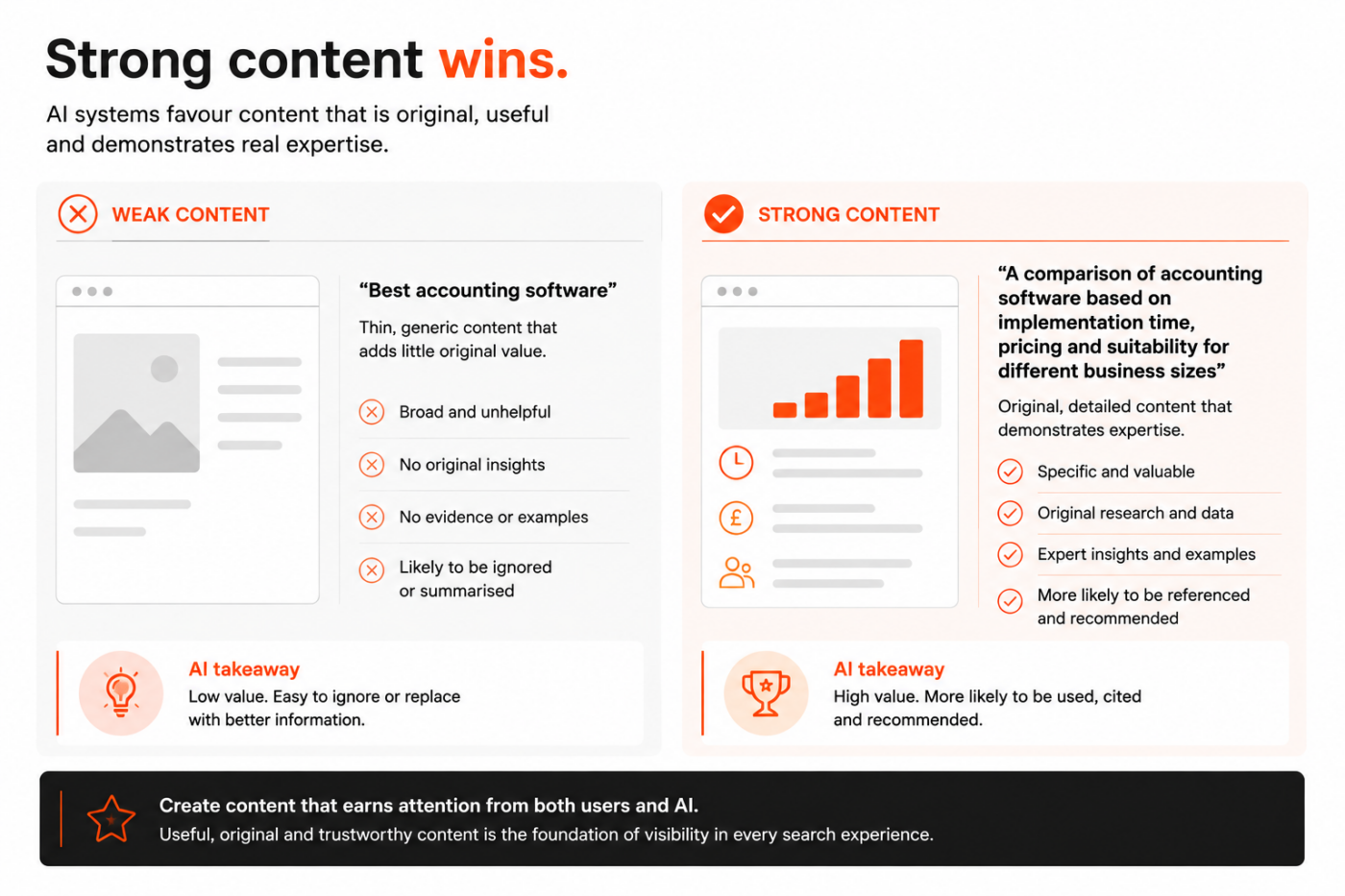
AI systems need useful information to work with, so thin pages, generic summaries and content that repeats a lot of what already exists elsewhere is unlikely to be treated as a valuable source. This ‘plague’ of AI generated content was recently addressed in one, or possibly two Google updates in March and June, which saw a mass-unindexing of countless pages and prompting genuinely helpful YouTube tutorials in order to fix.
Strong content answers real questions in a way that demonstrates expertise. It includes practical detail, first-hand observations, original data, clear definitions and transparent limitations. It also makes important claims easy to verify. Our legal clients had their traffic take off quickly through exactly this process – although content production took a little longer the results proved the theory time and time again.
Consider a software company targeting searches around accounting platforms. A generic article titled “Best Accounting Software” is unlikely to add much. A detailed comparison based on implementation time, pricing structure, reporting requirements, support model and suitability for different business sizes is more useful to a reader and easier for an AI system to interpret. Add evidence from customer projects, explain the assessment method and state where each option may be unsuitable, and the content becomes more credible still.
This is where subject-matter experts are crucial. Marketing teams can shape the structure and readability, but the strongest material often comes from people who deliver the service, advise customers or solve the problem every day.
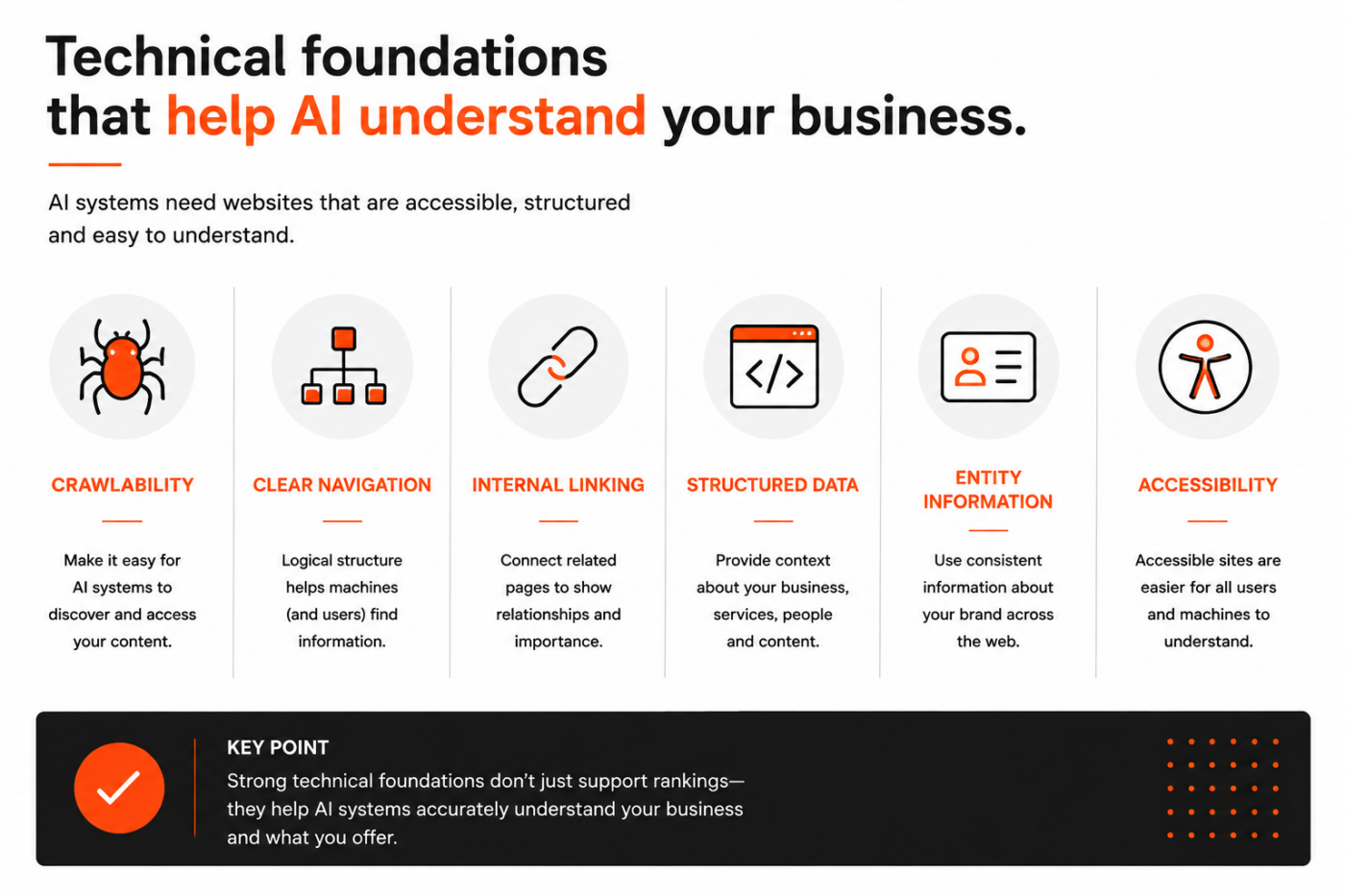
Technical SEO remains important because machines cannot use information they cannot reliably access or understand. A well-built website gives search crawlers, retrieval tools and other automated systems a clearer route through the business.
The essentials are familiar: pages should be crawlable, navigation should reflect the service structure, internal links should connect related topics, and important information should not be hidden behind scripts or interactions that prevent discovery. Fast, accessible pages also improve the experience for people arriving from any channel.
Structured data can provide additional context about organisations, services, products, locations, articles, authors, reviews and frequently asked questions. It is not a shortcut to recommendation, and markup should always match visible page content. Used correctly, it reduces ambiguity and helps machines connect information more confidently.
The strategic shift is that SEO is no longer only about helping a page rank. It also helps machines understand the business as an entity: its name, expertise, locations, people, services and relationship to other recognised entities.
Recommendations are ultimately trust decisions. Reviews, testimonials, forum discussions and customer feedback can influence how a brand is perceived, particularly when someone asks for the “best”, “most reliable” or “most suitable” provider.
A high review score is useful, but the detail is often more informative than the number. Repeated comments about responsiveness, implementation support, product durability or aftercare reveal the qualities customers associate with the brand. Repeated complaints reveal risks just as clearly.
Businesses should therefore treat review management as part of digital visibility rather than a separate customer-service task. Encourage genuine feedback, respond constructively, investigate recurring issues and avoid manufactured reviews. A credible reputation cannot be built through markup or content alone.
AI systems often need to reconcile information from several places. Conflicting details create uncertainty. Variations in business names, outdated addresses, unclear service descriptions, abandoned profiles or contradictory claims can make it harder to establish which information is current and authoritative.
Core facts should be consistent across the website, company profiles, directories, social accounts, partner pages and editorial coverage. This includes the official business name, locations, service areas, areas of expertise, contact details and the names and roles of key people.
Consistency does not mean copying the same paragraph everywhere. It means maintaining one recognisable version of the truth.
Yes, but the goal is broader. Traditional SEO has often been measured through rankings, clicks and organic traffic. Those metrics remain valuable because websites still need to attract and convert visitors. AI visibility adds another layer: recognition, citation, inclusion in generated answers and selection as a credible option.
The foundations overlap. Strong SEO creates accessible content, clearer site architecture, better user experiences and stronger authority signals. It also encourages businesses to understand search intent and answer customer questions precisely. Those same qualities make information more useful to AI-powered systems.
The difference is that success may not always result in a conventional click. A person may encounter the brand inside a comparison, use the answer to build a shortlist and return later through branded search, direct traffic or another channel. Measurement therefore needs to expand beyond last-click organic sessions.
We’ve been framing this in simple terms both internally and with clients, explaining that AI has given us tools to get from A to B much faster, but the real difference is how you get over the line – that’s SEO.
Businesses can improve the conditions that support visibility, but like SEO, they cannot guarantee that ChatGPT will recommend them for a particular prompt. Anyone promising a fixed formula should be treated very cautiously.
Models change. Retrieval methods change. Sources are refreshed. Answers can depend on wording, location, timing, personal context and the tools available to the assistant. Some questions may be answered from learned patterns, while others may involve current web retrieval or connected data.
Our approach has been to evolve holistically. Improve the quality and clarity of the company’s digital presence in ways that benefit search engines, AI systems and customers at the same time. That means strengthening brand recognition, publishing genuinely useful expertise, improving technical foundations and earning a trustworthy reputation.
This work is sometimes described as generative engine optimisation, answer engine optimisation or AI search optimisation. The terminology may continue to change. The underlying task is more durable: make the business easier to understand and easier to trust.
The most effective starting point is not a speculative AI tactic. It is a structured review of the signals the business already sends.
| Priority | What good looks like |
| Review digital foundations | Confirm that the website clearly explains what the business does, who it serves, where it operates and why its expertise is credible. |
| Create useful source material | Answer real customer questions with original insight, evidence, practical detail and contributions from subject-matter experts. |
| Strengthen authority | Earn relevant mentions through digital PR, partnerships, professional bodies, events, expert commentary and credible case studies. |
| Improve technical clarity | Maintain crawlability, logical navigation, internal linking, accessibility and accurate structured data. |
| Build reputation | Encourage genuine reviews, respond to feedback and use recurring sentiment to improve the customer experience. |
| Standardise entity information | Keep names, services, locations, profiles and key people accurate across owned and third-party platforms. |
| Measure broader visibility | Track branded search, referral sources, assisted conversions, AI referrals where identifiable and recurring brand mentions in representative prompts. |
Ask a colleague not involved with the website to explain the business after visiting the homepage and two service pages. Can they identify the offer, target customer, locations and distinguishing expertise? If a person struggles, a machine is also likely to encounter ambiguity.
Audit outdated pages, duplicated service descriptions and unsupported claims. Strengthen author profiles and make the relationship between expertise, services and evidence explicit. Important facts should be available in normal page content, not only in images, downloadable brochures or sales conversations.
Map the questions customers ask during research, evaluation and implementation. Publish answers that are direct enough to be extracted but detailed enough to be trusted. Descriptive headings, concise definitions, comparison tables and clearly labelled evidence all improve usability.
Avoid producing large volumes of generic content simply to cover keywords. Content should contribute something: an informed opinion, a tested process, a benchmark, a useful framework, an explanation of trade-offs or evidence from real work.
Digital PR and brand building become more important when answers are assembled from multiple sources. Identify the publications, communities, associations and experts that already influence the target market. Contribute expertise where it is relevant, rather than distributing low-value press releases or pursuing unrelated links.
Partnerships can also create useful corroboration. Supplier profiles, integration directories, event speaker pages and joint case studies can establish relationships and areas of expertise in a way that is both human-readable and machine-readable.
Run a technical audit covering indexability, rendering, canonicalisation, internal linking, page speed, mobile usability and accessibility. Review structured data for accuracy and consistency. Check that old domains, duplicate profiles and legacy URLs do not compete with the current business identity.
Technical work will not create authority on its own, but it can prevent good evidence from being overlooked.
AI visibility is difficult to measure with one metric. Referral traffic from AI platforms can be tracked when it is passed to analytics, but many journeys will not produce a direct click. A broader framework should include branded search demand, direct traffic, assisted conversions, referral growth, share of relevant third-party mentions and the quality of citations earned by key content.
Prompt monitoring can provide directional insight when handled carefully. Use a fixed set of realistic customer questions, record the date, model and location where relevant, and look for patterns over time. Do not treat a single answer as a stable ranking position.
There’s no secret sauce, no formula that everyone else has that you don’t. Much of the success we see in our clients work and across the wider SEO community stems from historic, strong SEO foundations – not a magical AI strategy that was actioned over night. The important thing is to keep momentum, continue to experiment and explore how developments in search may offer opportunities for better websites, not just a race for month-on-month increases to ChatGPT citations.
For many agencies, their B2B clients have one clear objective from SEO investment – increased lead generation. This doesn’t change with AI and zero-click search replacing traditional traffic.
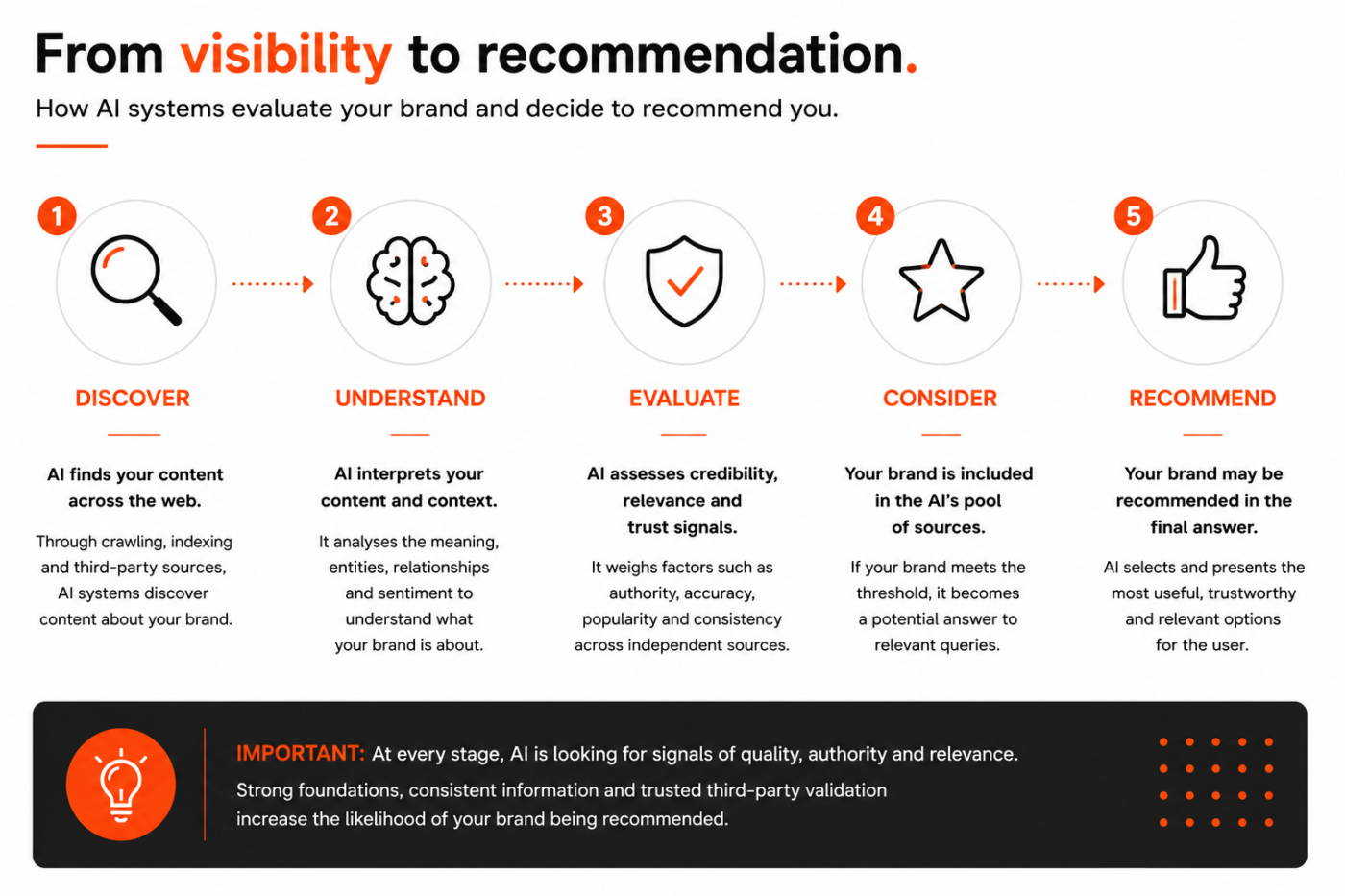
The next phase of digital marketing is not about expanding the definition of SEO and general search visibility.
That requires holistic efforts across search teams. Technical SEO makes information accessible. Content strategy turns expertise into useful source material. Digital PR and brand activity create independent recognition. Website optimisation helps people understand and trust what they find. Analytics connects those efforts to commercial outcomes.
This is also why businesses should avoid chasing short-lived tactics. AI platforms will continue to evolve, and their answers will never be completely controllable. Strong digital entities are more resilient. They are clearly defined, consistently represented, independently referenced and genuinely useful.
McKinsey’s 2025 global survey found that 88% of respondents said their organisations were using AI in at least one business function, yet nearly two-thirds had not started scaling it across the enterprise. The same gap is visible in marketing: adoption is moving quickly, while many organisations are still deciding how AI-era visibility fits into their wider strategy.
The businesses best placed to benefit will not be those looking for a way to hack one assistant. They will be those that invest in the foundations that make them discoverable and credible wherever customers look for answers.