E-E-A-T Explained: The Secret to High-Ranking, Trustworthy Content
Struggling to rank on Google? Learn how Experience, Expertise, Authoritativeness, and Trustworthiness (E-E-A-T) impact SEO — and how to improve your content today.



In the recent world of search, you’ve probably noticed there’s a new acronym waiting around every corner. AI SEO. GEO. AEO. Search Experience Optimisation. The list seems to grow faster than Google’s algorithm updates.
B2B SEO isn’t another buzzword to add to the pile.
It’s simply an SEO strategy designed around how businesses research, compare and ultimately buy from other businesses. While that sounds quite obvious, the reality is that a company looking for a new manufacturing partner, software provider or digital agency behaves very differently to someone shopping for trainers or booking a weekend away.
That means the SEO strategy should reflect these differences.
Perhaps more importantly, success in B2B SEO isn’t measured by attracting the most traffic. It’s measured by attracting the right people at the right stage of their buying journey – search intent is everything for B2B.
There’s no hiding that seeing traffic and clicks shooting upwards is satisfying and comforting for stakeholders. But the reality is your finances have never been able to use “more website visits” as capital. For most SMEs, one qualified enquiry can be worth more than thousands of irrelevant clicks, and pay for months of SEO work a few times over.
If you’d like a broader look at how search has evolved beyond rankings alone, our guide to Modern SEO is a good place to start:
The short answer is that Business to Business SEO is the process of improving your visibility when other businesses are searching for your products or services.
Rather than focusing purely on search volume, B2B SEO is built around commercial intent.
Someone searching for solutions such as:
isn’t usually browsing for entertainment. They’re researching solutions to a genuine business challenge.
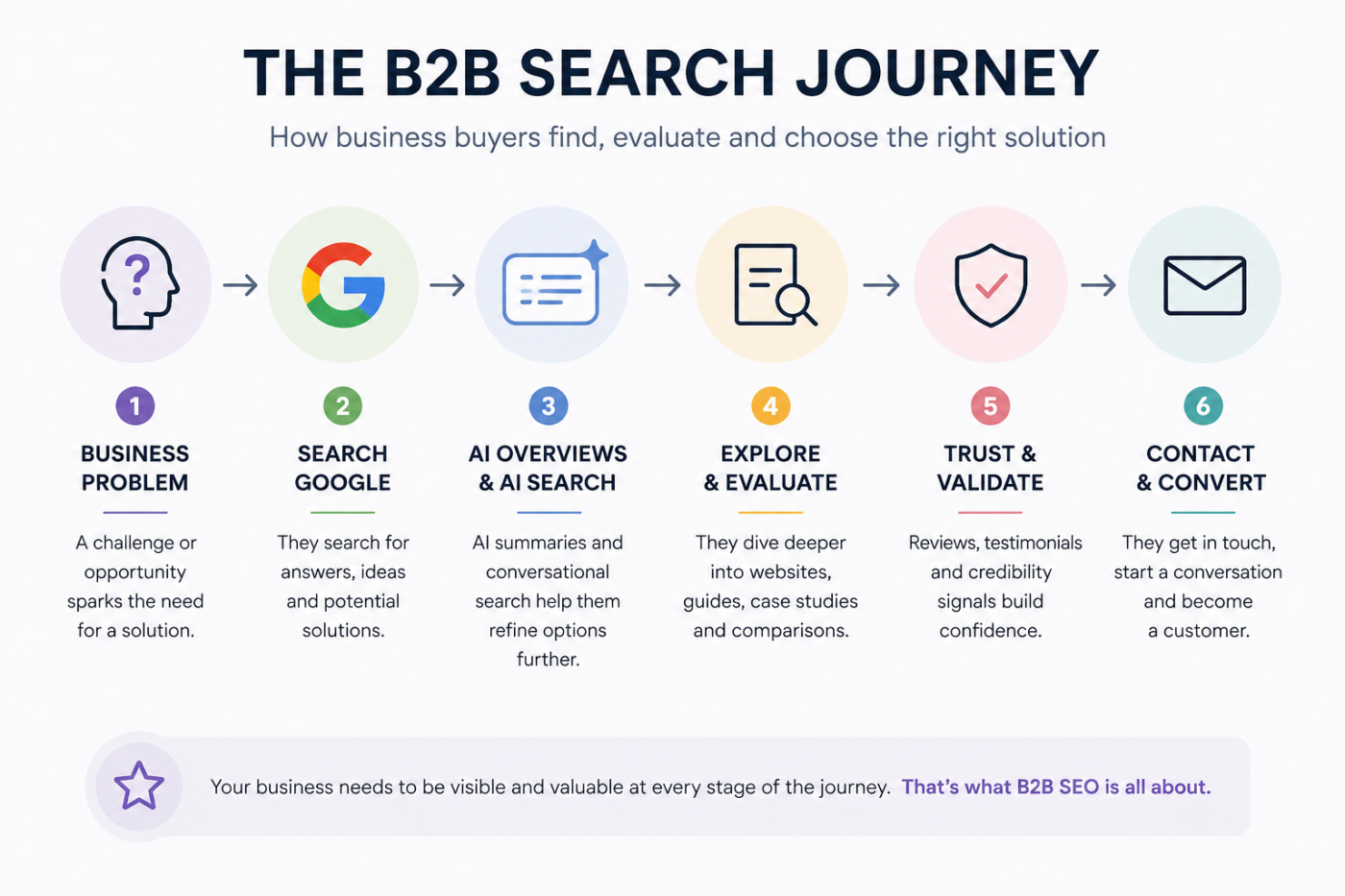
Unlike many consumer purchases, there is rarely one search followed immediately by a purchase. Instead, prospective clients might spend weeks, or even months, researching options before speaking to a supplier. Typical B2B search behaviour includes:
SEO needs to support every one of those moments.
One possible misconception is that Google somehow treats B2B websites differently, but under the hood it really doesn’t.
Google still wants to show the most relevant, trustworthy answer and deliver that to the right users.
The actual key difference is the person sitting behind the keyboard typing.
Business buyers tend to ask more detailed questions, perform more research and involve multiple decision makers before making a purchase. Their search language is often far less generic or broad, so that changes the type of content they need.
A good example is thinking about a consumer might search once, maybe twice before confidently buying something for £50.
A company investing £50,000 into a software platform or manufacturing equipment would be more likely to perform dozens of searches before making a commitment.
This is why successful B2B SEO focuses less on chasing individual keywords and more on becoming the trusted authority across an entire topic.
That approach has become even more important as search behaviour changes. According to BrightEdge’s 2025 research, overall search activity continues to grow alongside AI powered discovery, demonstrating that businesses are asking more questions across both traditional search and AI experiences rather than abandoning Google altogether.
One of the easiest ways to waste an SEO budget is by chasing impressive looking search volumes, and it’s something we’ve seen Google start to crack down heavily on this year.
Imagine your business manufactures specialist industrial flooring – you could spend months trying to rank for something like “flooring.”
Or you could focus on searches like:
The second group may receive a fraction of the monthly searches, but every visitor is significantly closer to becoming a customer. That’s the difference between visibility and relevance, and a big reason why LLMs are so popular. People get more accurate and tailored results than they’ve ever seen before, and the consensus is that ChatGPT and co deliver much more qualified traffic than any other channel..
So this means the best B2B SEO strategies have to be built around understanding intent:
Your website should answer every one of those questions.
Publishing endless blogs because someone said “Google likes fresh content” rarely delivers meaningful enquiries.
Instead, every piece of content should serve a purpose.
That could mean:
Case studies deserve particular attention, and they can answer one of the biggest questions every prospective client has:
“Can these people actually deliver?”
Rather than making bold claims about your expertise, case studies give you the best platform to actually show it.
Our work with property specialists Black Brick, patent attorneys Bailey Walsh and manufacturing market leaders Timbermat all demonstrate how tailored SEO strategies can help businesses operating in very different sectors improve their online visibility while generating commercially valuable enquiries.
Those examples often carry more weight than pages filled with marketing jargon because they provide real evidence of outcomes.
Not long ago, securing the top spot on Google felt like crossing the finish line. Today, it feels more like earning a place on the starting grid. Search has evolved far beyond ten blue links, with Google increasingly answering questions directly through AI Overviews, while platforms like ChatGPT, Gemini and Perplexity help users discover businesses without necessarily sending them to dozens of websites first. Ranking well still matters, but visibility across the wider search ecosystem is becoming just as important.
According to Ahrefs’ June 2025 research, AI Overviews reduced click through rates by around 34.5% for many informational searches, despite rankings remaining unchanged.
At the same time, SparkToro’s ongoing research shows that more searches now end without any click at all than those that send users to external websites.
It’s not saying that SEO is dead, but it’s pushing towards authority becoming more valuable.
Businesses that consistently publish useful content, earn trusted mentions, demonstrate expertise and build strong brand recognition are more likely to appear wherever people search, whether that’s Google, AI assistants or industry publications.
This is exactly why we’ve expanded our own services beyond traditional SEO to include dedicated AI search visibility strategies.
If your business is still measuring success purely by keyword rankings, you’re probably looking at yesterday’s scorecard.
There’s a common misunderstanding that Local SEO only matters for cafés, dentists and plumbers.
In reality, many B2B searches include a location, even when the customer could technically work with businesses nationwide.
Think about searches such as:
People often want the reassurance of working with a business that understands their market, can attend meetings when needed and has experience within their region.
Strong Local SEO also reinforces wider trust signals through reviews, Google Business Profile optimisation and locally relevant content.
Even if your ultimate goal is national visibility, local authority is often where that journey begins.
Perhaps the biggest shift over the past two years isn’t AI creating content, but how AI is changing how people discover businesses.
Many buying journeys now begin with questions asked directly inside ChatGPT, Gemini or Google’s AI powered search experiences.
That means businesses need to think beyond rankings.
BrightEdge’s 2025 analysis found that while AI search referrals are growing rapidly, traditional organic search still delivers the overwhelming majority of conversions. Rather than replacing SEO, AI is expanding the ways people discover businesses.
That’s why modern SEO isn’t about choosing between Google or AI.
It’s about becoming visible wherever your future customers are searching.
If you’re unsure how visible your business currently is across AI powered search experiences, our free AI Search Visibility Audit provides a practical starting point.
A successful B2B SEO campaign should ultimately be judged by metrics that support business growth.
Metrics that B2B SEO can use to measure success include:
The irony is that some of the most successful SEO campaigns actually result in less traffic, because they stop attracting visitors who were never likely to become customers in the first place.
Fewer visits but higher conversion values is a trade that anyone would make.
Large corporations often have bigger budgets, bigger marketing teams and stronger brand recognition.
Fortunately, Google doesn’t rank websites based on turnover.
SMEs can compete exceptionally well by demonstrating expertise within a specific industry, producing genuinely useful content and answering the questions their customers are already asking.
That’s where a focused B2B SEO strategy makes the biggest difference.
Rather than trying to become visible for everything, you become known for the topics that matter most to your ideal clients.
At First Internet, that’s exactly how we approach SEO.
Whether we’re helping ambitious SMEs improve their local visibility, expanding their presence in AI powered search or building long term topical authority through content, the goal remains the same.
If you’d like to understand where your website stands today, explore our SEO Manchester service, learn more about our AI SEO approach or start with our free AI Search Visibility Audit. They’re all designed to help businesses build lasting visibility in a search landscape that’s changing faster than ever.