8 Benefits of SEO for SMEs & UK Businesses
Discover the 8 biggest benefits of SEO for your online business 20+ Years Expert Advice ✓ Real-life examples included ✓ 5 Minute Read →



Search Engine Optimisation in 2026 is less about ranking position one in Google, and more about building a search visibility strategy that solves problems of modern user intent at multiple entry points.
Keeping up with SEO in 2026 hints at comparisons to a time working in frontend web development, in the sense that the rate of evolution could feel too quick to ever feel comfortable fully caught-up with. The best approach with coding was to stick to a certain lane within that field, learn it, practice it, then move on to exploring the latest trend or technology. After a regrettable series of visits to a mechanic, a conversation ensued about their approach to the advent of EV. In one way it’s an evolution of what his business is built on, but even in 2026 there was no appetite to adopt this and actually no immediate need to.
SEO doesn’t have that luxury to simply say no. Rapid change is unavoidable in the wider world of marketing, and mastering trends are critical to understanding your market and satisfying your clients. A few years into normalised adoption of LLMs, vibe coding and zero-click AI overviews, how do we explain what SEO actually is in 2026?
Visits to a website is the ultimate vanity metric which in all honesty, nobody wants to ever see decline, no matter how justifiable it is (and can even be a good thing). There’s something in our recent corporate evolution that struggles to see past a chart trending up or down. If you’re working in the SEO world, you’ll have been a very lucky individual if drops in website traffic aren’t a panicked query you’ve had to explain.
By 2024, ChatGPT was fairly well adopted into the mainstream, built into peoples phones and office systems. In the simplest form, those quick informational queries were now handled faster and more precisely than ever before, so straight away you lose the informational traffic acquisition that previously a blog or guide (and therefore a ‘click’) would have gained.
The wider data supports this too. A 2024 study from SparkToro found that less than half of Google searches now result in a click through to the open web, with the majority ending directly on Google itself or through “zero-click” behaviour. As AI Overviews and LLMs become more integrated into search, informational traffic is naturally one of the first areas to feel it.
There’s a reasonable challenge to be made though that it wasn’t just meaningless traffic. If somebody enjoyed the content, engaged with it, or found their answer through your brand, that still carried value. Whether it’s through brand familiarity, future searches, or simply the positive engagement signals historically fed back into search, that traffic may have brought purpose.
In 2026, search result pages look wildly different to even 5 years ago, and not since the advent of paid search ‘ads’ has such a dramatic change been seen. These Ads could frustrate both SEO professionals and your average user. It was often second nature to scroll down instinctively after a search and trust the organic results as the answers to actually look for. Depending how far back you look, paid results accounted for only 4-5% of clicks on page one – a reliably smug statistic for SEOs to whip out.
Almost halfway into 2026, the results page in Google now consists of multiple elements which digital marketers need to strategise for:
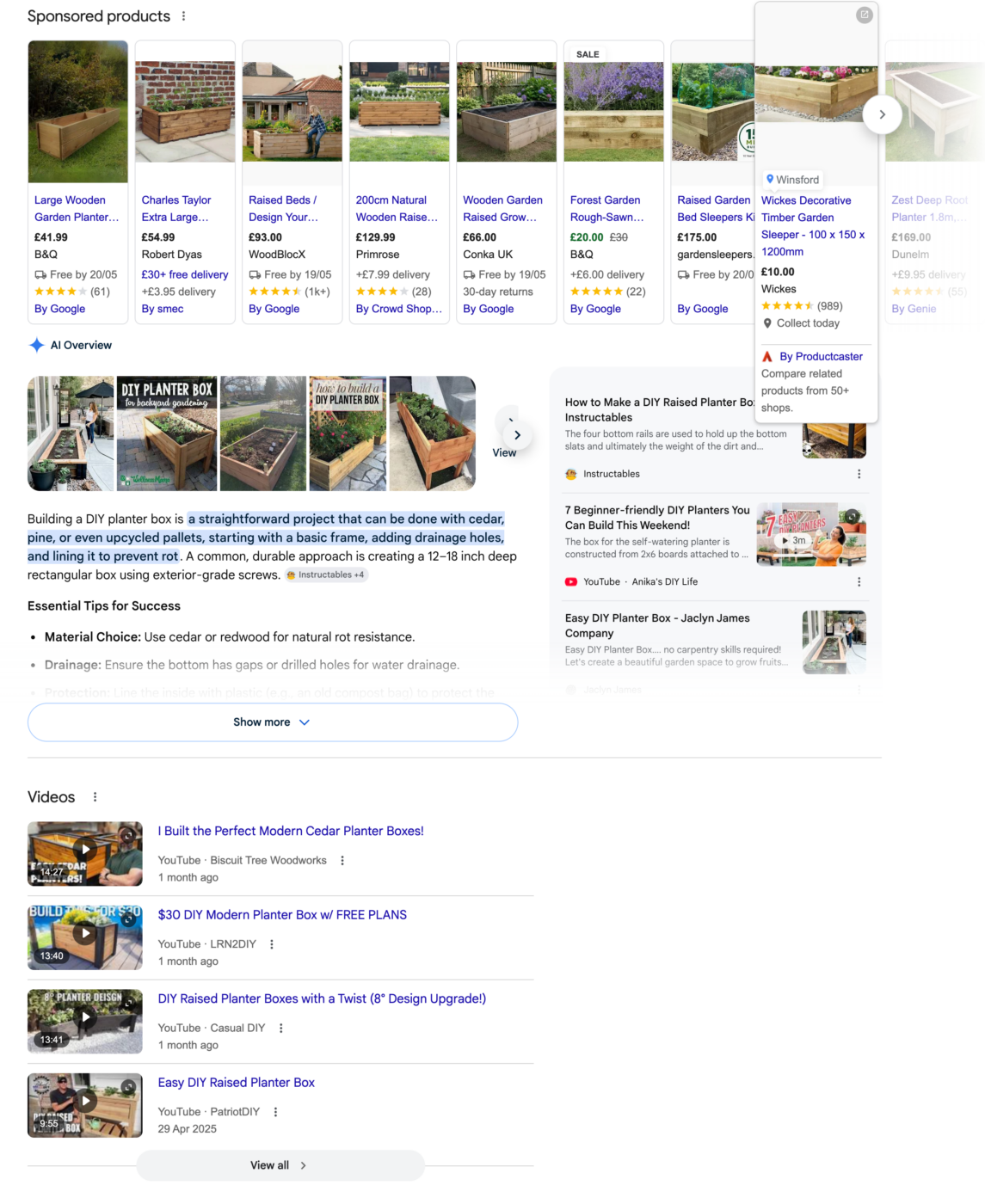
FUN GAME: Do a search like ‘LED lighting for bedroom’ (or something more adult) and count how many of these elements you can tick off. This may be liberal use of the word ‘fun’.
So how do SEO professionals approach a search strategy that makes an impact across such a menagerie of search result features? The answer starts with accepting that ranking #1 is no longer the sole objective. Modern SEO strategy in 2026 has become more about overall search visibility, brand presence and owning as much of this results page real estate as possible. We really need to understand how your audience searches and what experience Google can deliver to satisfy that intent.
The exciting news is that with variety comes opportunity – whether that’s trusted organic listings, shopping feeds, enhanced local results, images, or the AI zero-click layer sitting above it all. Yes things aren’t as simple, but that’s really not a bad thing.
Keyword rankings used to feel wonderfully simple and the simplest entry point to explaining how SEO works. Keyword research led to keyword optimisation, and in its most basic form resulted in better rankings. This version of SEO is pretty much gone.
For years, “position one” was the holy grail because the click-through rate difference was enormous. Various industry studies regularly showed the top organic result capturing anywhere between 25-40% of all clicks, while anything below the fold rapidly fell exponentially into oblivion. This made attributing the value of rankings super easy and genuine.
The issue in 2026 is that “position one” often isn’t really at the top anymore, and the instinctive skip past ads now skips a lot more. For most searches, the first traditional organic result is halfway down the page and effectively hidden without scrolling.
Even keyword reporting itself became a headache. In September 2025, Google quietly disabled the long-standing &num=100 search parameter, which many SEO tools relied on to pull larger batches of ranking data. The result was wild volatility across rank tracking platforms and sudden drops in impressions inside Google Search Console, despite traffic and real-world rankings often remaining relatively stable.
However, SEO was already moving away from the old “one page per keyword” mentality, and good strategies will have found this transition into modern SERPs smoother. Keyword spamming and shamelessly forcing identical phrases into every second sentence (I’m shaking my fist at you, recipe websites!) has gradually been replaced by entity relationships and content clusters. Modern search engines are considerably better at understanding context and intent, which means the best-performing sites are ones demonstrating the strongest overall understanding of a particular topic.
Search engines are now significantly better at understanding intent, context and quality than our industry was ever prepared for. Plenty of SEOs would try to game the results (not in a malicious way, it’s just what worked) by producing content, or even whole websites, written purely to rank and capture traffic. As things moved on, this tactic died off and various updates over the years helped to alleviate the issues this could have brought.
We’ve now very quickly reached a stage where search engines feel like they’re ahead of the gamification. That’s why writing to genuinely provide value with original opinion has become more important again. If your page doesn’t helpfully answer the question that prompts a search in the first place, you’ll lose the visibility across more than just an organic ranking.
The wider digital customer journey has changed massively too. Research throughout 2025 found consumers increasingly arriving at websites much later in the decision-making process, often after already using AI tools to compare products, research services or build shortlists. This will make sense from your own experiences, where miniscule queries are now being directed into search engines rather than part of a wider search journey. A study from Invoca found that 41% of consumers were already being influenced by generative AI before ever contacting a business, particularly in high-consideration purchases.
What this can bring though is a healthier distinction between informational visibility and commercial intent, which is a great entry point for SEO content strategists.
As alluded to earlier, informational content still absolutely has value. It builds familiarity and brand recognition over time, which is difficult to measure but equally tough to argue against. Somebody finding your guide, study or explanation today can become a high-intent branded search months or weeks later.
Speaking of intent, lower funnel searches for locality, buying and services are where SEO is proving most commercially resilient. Those kinds of searches where users still need reassurance and human authority, rather than just a quick answer generated instantly by AI. A service still needs to be provided, a product still needs to be made and sold, so focus on that endpoint.
“Search engine” is no longer just another word for Google. While the Alphabet goliath still dominates the global landscape, its share has started to erode at the peak. Across 2025–2026 estimates, Google’s global search share has dipped below 90% as AI giants like ChatGPT, Perplexity and other generative systems take the brunt of more and more informational queries.
It’s widely accepted that this isn’t reflecting a decline in people using Google – there’s enough to suggest that activity in search is actually increasing (we’ve all searched some real dumb stuff the last couple of years). The spread of where and how we choose to search is just changing. AI overviews answer without scrolling, Reddit has been gentrified, TikTok is heaven for tech-savvy shoppers.
This fragmented search results journey is also reshaping the job market. Throughout 2025–2026 there’s been a clear rise in GEO (Generative Engine Optimisation) and AI visibility roles which has certainly rocked the opinion boat on what this would actually involve as a fully scoped role vs. traditional SEO.
One question we’ve seen from clients has been centered on CTR and conversion. The data is still difficult to manage accurately, as well evolving in its own infancy, but early benchmarks suggest AI-assisted or generative search traffic can convert at significantly higher rates than traditional organic sessions in some contexts, even as overall click volumes decline. At the same time, studies show organic click-through rates can drop sharply when AI Overviews appear, in some cases by 50–60%+, particularly for informational queries.
This is actually the fun part. AI has bedded in, the standards are higher and the audience have to come first. There’s a lot more to learn and grow into.
Good SEO in 2026 is no longer a role built around ranking pages and positions in Google. It’s a digital visibility system with multiple entry points to explore and build around. Your audience enters through AI Overviews, LLMs, traditional organic results, social platforms, PR coverage, and even uses increasingly advanced hardware to get there. The job of an SEO now is, where it’s feasible, building a strategy to grow presence across the spectrum.
We haven’t gone into detail on this guide (Digital PR specialists can explain this better than us), but even link building falls into the same ethos of quality over quantity, with real-world validation playing a crucial role in brand building and trust. Brand mentions are accepted to be one of the key attributes to build up referrals from AI prompts, and quality, relevant links from trusted sources are a fantastic way to achieve this.
A final nod (perhaps unfairly) to technical SEO, which is still there, and still boring, but arguably just as important than ever. If AI systems and search engines are doing more interpretation for you, then crawlability, structure, clarity and performance become the baseline that everything else depends on. For years we’ve championed the value of technical SEO and the foundations it helps set up for everything else. The importance of user experience and crawlability won’t diminish any time soon, especially in the wake of vibe-coded and AI generated spam.
When discussing AI and how integrated it is in modern behaviour, I consider what fresh-faced director Kane Parsons alluded to in a recent interview, describing the idea of “society roleplaying as itself”, creating a closed loop where users are accepting a generated and summarised version of reality from its own content.