Are hashtags still worth using on social media platforms?

Serena


Back in the day (about three years ago), you’d never see a social post without a hashtag.
They were known to increase engagement and reach on posts, helping users to discover content they cared about, and allowing brands to target audiences within their niche.
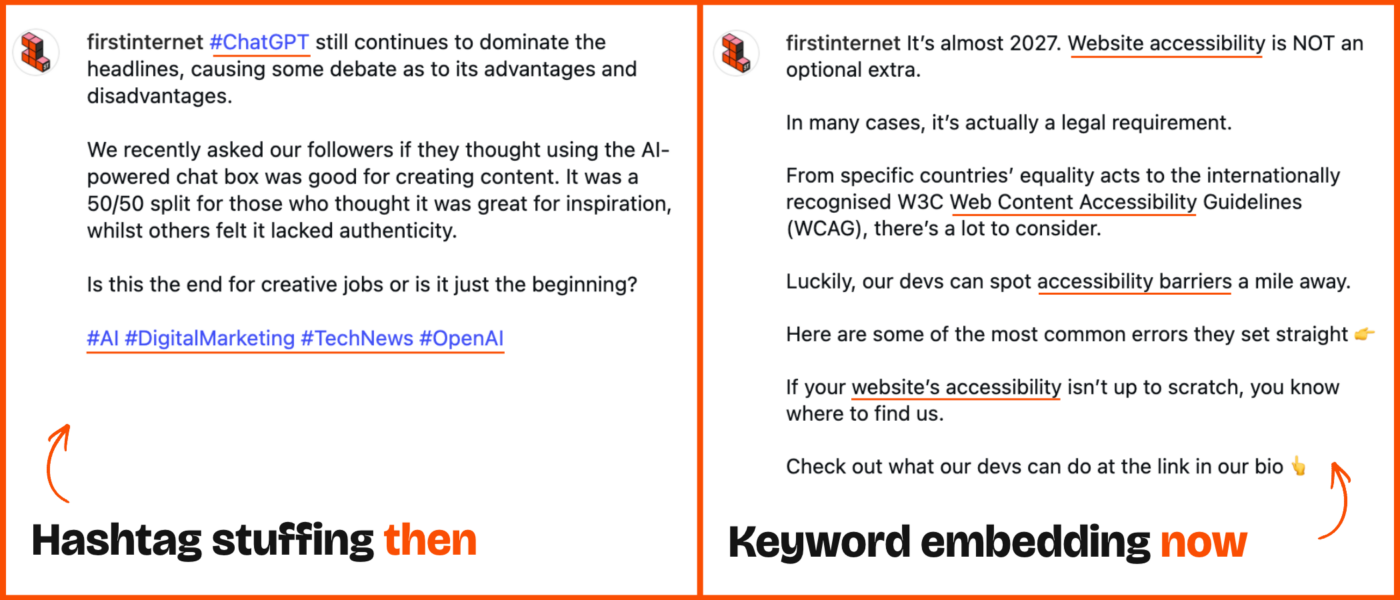
Many business owners are still operating on the assumption that stuffing thirty hashtags at the bottom of their post is going to get them noticed. That, by using popular (and most likely very irrelevant) hashtags, their impressions will skyrocket.
But for the past year or so, they’ve been quietly disappearing.
As social media algorithms become more and more advanced and users start to engage in different ways (silent lurkers, hello, we’re talking to you), hashtags aren’t necessarily the reach-building tool they used to be.
But what’s replaced them, and how do we find new ways to promote our social media content and please the algorithms? Let’s find out.
Let’s bring it back to basics. To truly understand whether hashtags are still worth using, we need to know why we don’t see them as much anymore.
When hashtags were first introduced (by a man called Chris Messina on Twitter way back in 2007), they were used as a way for users to categorise their posts. They quickly spread to other social platforms.
Back then, algorithms couldn’t simply analyse a photo or a caption and understand its topic. They relied on hashtags to understand what each post was actually about.
Fast forward to today and towards 2027, and platforms use advanced AI to analyse the words in your captions, on-screen text, spoken words in videos and even objects that appear on screen in several key ways:
Social media has become a search engine in its own right, particularly for Gen Z.
According to Sprout Social, nearly one in three consumers skip Google altogether, instead opting to start their search journey on the likes of TikTok and Instagram.
Thanks to advanced AI algorithms that track much more than just individual words or hashtags, they no longer need to search for specific hashtags to get the results they’re after.
Hashtags used to be a valuable community-building tool, encouraging users to share their own content using the same hashtag. But now, audiences are much more passive in the ways they interact with social content, especially when it comes from brands, rather than other individuals.
According to research from Ofcom earlier this year, only 49% of adult social media users actively post, share or comment, down from 61% in 2024. If less and less people are willing to comment or share a post, you can bet they’re not going to be snapping pics just to share them to your brand’s hashtag any time soon (unless there is a particularly good product giveaway to be had in doing so).
Users are also increasingly aware of methods like ‘keyword stuffing’, where posts are deliberately crammed with keywords and hashtags to attract more visibility. This can risk your brand looking disingenuous and inauthentic – as though it’s desperate for more views, rather than to actually build a community organically.
AND, social platforms like TikTok are actively taking measures to limit the number of hashtags you can use.
Attention spans are also a huge factor. According to Sci Tech Today,Gen Z averages just 6.5 seconds of attention per social media post, and users typically encounter between 9,000 and 12,000 ads every day.
With infinite feeds and intense post bombardment, users increasingly prefer concise messaging. When attention spans are this low, every word counts.
What can you do now to make platform algorithms understand your content?
Social media SEO: The best way to get seen.
Just like traditional search engine optimisation (SEO), social SEO is the practice of optimizing your social media profiles and content so that they’re easily discovered – both within social platforms themselves and across external search engines (aka Google) and AI-powered search.
Here are some of the social media SEO techniques that we use for our clients:
The short story? It depends on the platform.
The long story? Let’s break it down.
| Platform | Worth it? |
|---|---|
| Hashtags can be a way to add extra context, but strategically placing keywords in captions and on-screen text is what matters most. You only get five hashtags maximum on all post types – so, if you’re going to use them, use them sparingly (and nothing generic like #Reel)! | |
| TikTok | Again, strategic keywords are the way to go. TikTok users often head to the in-app search bar if they’re looking for reviews of specific events, places or products – so that social SEO is VITAL. Hashtags are still useful to add context, but we’ve noticed a sneaky trend in the performance of our recent TikTok posts. Those without hashtags have been achieving better reach than those with them, so we’re inclined to say that you don’t really need them on TikTok either. |
| LinkedIn’s algorithm is great at reading the words on your post to decide which audiences to push it to. 1-2 hashtags won’t hurt you, but we’d recommend a big fat 0. If you’re a social SEO whizz, they don’t really serve a purpose (plus they can risk your brand’s content looking unprofessional and spammy). | |
| Facebook’s algorithm rewards content that sparks conversation, not content stuffed with as many hashtags as possible. Focus on community-engaging techniques that encourage users to respond in the comments. | |
| X (formerly Twitter) | Hashtags still serve a purpose on X, especially when it comes to commenting on live events. It’s still common for users to search for trending hashtags on X if they want to join a specific conversation. If you’re inserting yourself into an evolving debate, pop a (relevant) hashtag on there to give your post a better chance of popping up to an engaged audience who actively wants to read about your subject. |
Rather than indiscriminately planting a few hashtags on there, you need to think about the whole package.
Give social algorithms as much information as possible at every touchpoint – but make it strategic, not blatantly obvious.
On X (Twitter), yes (when done right and NOT overused). But on other social media platforms, you simply don’t need to bother anymore. In fact, you could risk diluting your message or looking out of date if you use them.
Instead, implement strong social SEO, embed relevant and semantically appropriate keywords in your copy, and focus on creating value-led, quality content that users actively want to engage with.
Unsure where to start? Our social media experts can help.